

Welcome to Saving Terra
Educated, cautious optimism is the core philosophy of Saving Terra.

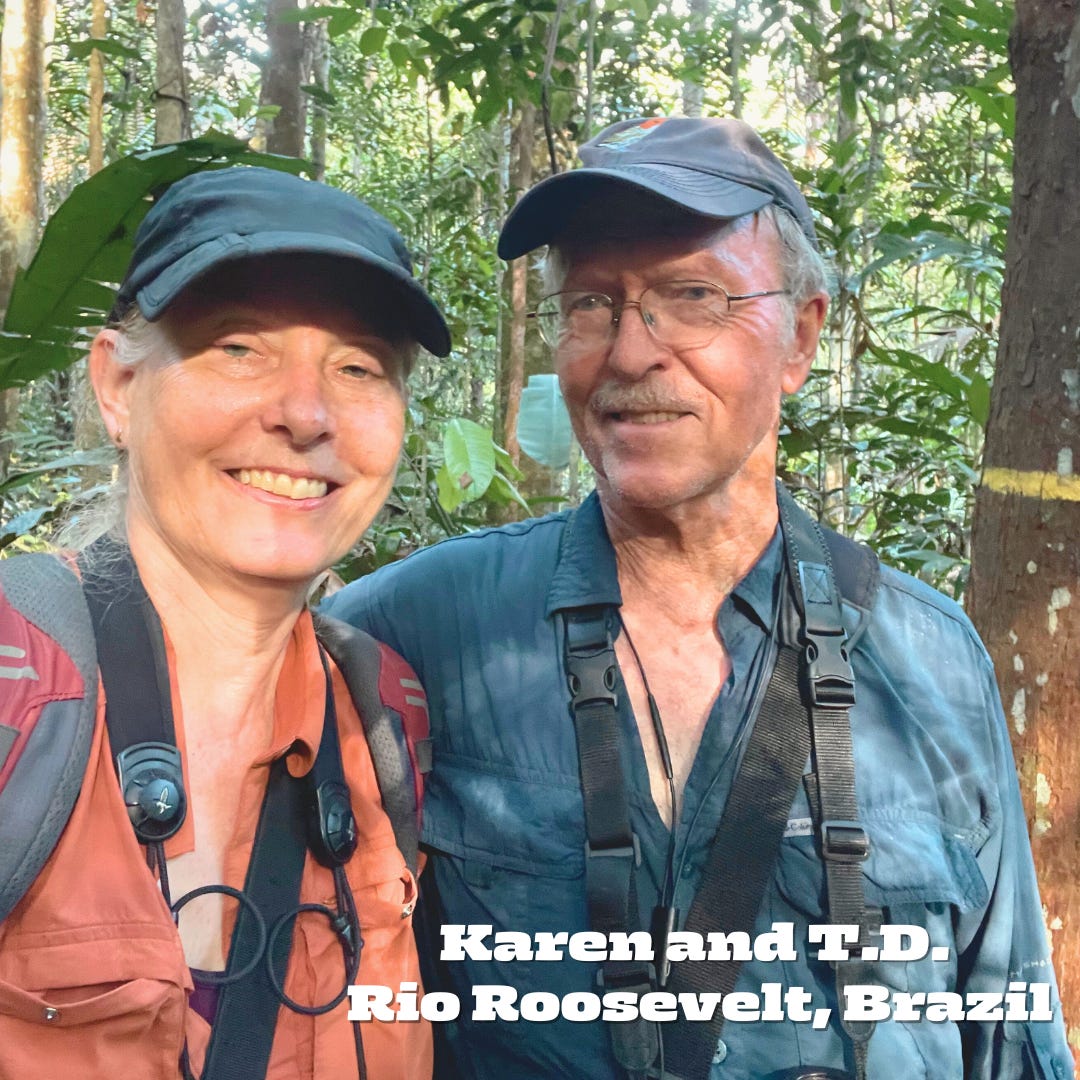
This platform is dedicated to promoting the preservation of biodiversity in forests and savannah habitats worldwide. (As used here, biodiversity refers to both the uniqueness and species richness of a habitat or entire biogeographic region.) It grew out of my international bird-centric, eco travels which have taken my wife Karen and I to all seven continents, most frequently to South America and Africa. And we are in good company!
According to the U.S. Fish and Wildlife Service, about 45 million Americans identify as birders, ranging from casual backyard observers to passionate ornithologists and everywhere in between. Many more are overseas. As the largest and fastest growing outdoor activity in America, it is predicted that over 2.5 billion dollars will be spent on bird related equipment and travel alone this coming year, and the global ecotourism market was valued at USD 185.87 billion in 2021 with projections nearing 15% growth from 2022-2030.
While we certainly welcome the company, all too frequently it seems ecotourists aren’t prepared for the habitat devastation and societal challenges they witness and/or don’t understand the severity of the impacts they encounter in their travels. Seeing these issues up close tends to leave folks shaking their heads, saddened by the losses and some choose to send funds to a favorite conservation organization upon their return.
Is this enough? Let’s explore the problems a bit deeper.
The most biodiverse habitats on earth are contained in tropical rainforests. It is impossible to venture to these places without encountering massive deforestation brought about by organized commercial activities, such as mining and logging, on the one hand, and subsistence farming on the other.
Challenges and devastation are unavoidable in the exploration of savannah habitats as well. East Africa is a mecca for ecotourists hoping to observe what is perhaps the biggest wildlife spectacle on earth; the African savannah. Countless tour groups and safaris pursue the mammals, birds and reptiles of the veldt unaware that organized poaching and wildlife slaughter for local markets is taking place on the very same land. It’s complicated. And the planet’s biodiversity is paying the ultimate price.
Is there something the ecotourist can do to further the biodiversity of the places they visit? I think there is.
Education
First, in advance of travel, ecotourists can educate themselves about the biodiversity resources that exist in the places they will be traveling. As my travels unfold, I will share how I go about this and hope to have you along for future trips if even only via this platform. To start, this involves pairing the animals travelers hope to see with the varied habitats -ecosystems- they will be visiting. Ecotourists headed for a South American country for example, may be visiting four kinds of forests or forest remnants and two kinds of savannah. Each of these contains it’s own unique palette of species.
For each specific habitat, there are corresponding threats to the preservation of biodiversity. It will not be the same in every country, even for a similar habitat type, so we are fortunate to live in an era where such threats and information are well documented and easily found with a quick Google search. So at the same time that ecotourists are learning about habitat diversity for their trip, they can also learn about the threats to the habitats and individual species within them, thus enabling travelers to see the wonders of the resources in contrast to the real dangers of losing them forever. Having this knowledge in hand can then be supplemented in the field by asking tour guides other local informants to explain what is happening from their perspective while witnessing both the biodiverse resources and their antithesis.
Ok, then what? Educate. Share the knowledge. Education is action. Take the stories, the photos, videos and recordings you have made and spread the word to those that live vicariously. This platform is simply that on a large scale. Via this Substack, and our podcast Saving Terra, we aim to educate and enable action. An individual ecotourist for example can present photos to their local Audubon group, or community, which on its own is a fine contribution, but when adding the knowledge and understanding of first hand accounts, a travelogue or photo safari becomes a real life glimpse of the beauty as well as the challenges happening on the ground. Those that appreciate the resources will also be the most motivated to preserve them.
Tangible action
Here’s the rub. What value does education have if it seems there is nothing that can be done? The threats many times seem overwhelming when compared to efforts to preserve biodiversity, leading to the attitude on the part of many ecotourists to be: “see it now while you still can”. I personally believe that there are solutions that may work, but in addition to education, caution too is advised.
Educated, cautious optimism is the core philosophy of Saving Terra.
Thankfully, there are ardent conservationists in every country, some of whom have been guides on our travels and will contribute to our efforts here. Many local scientists and concerned citizens have identified not only threats to biodiversity, but also programs that can counter deforestation and loss of savannah A good example is Las Grallarias, a forest preserve on the west slope of the Andes in Ecuador. It was started by Austinite Jane Lyons, who first purchased a small farm and built an ecolodge. Through conversions of agricultural lands to forest and additional purchases, Las Grallarias now extends preservation to hundreds of acres of highly biodiverse subtropical forest. Programs and analysis are being done by various NGO’s devoted to preserving biodiversity as well, such as Rainforest Trust, which has preserved large tracts of the Amazon rainforest. (Its website states that 92% of the forests they have purchased have loss less than 5% of forest cover.)
Understanding these programs and efforts is important to promote hope among fellow conservationists and travelers, but understanding alone is not enough to ensure either implementation or effectiveness. That is another aim of Saving Terra: to evaluate and highlight what can potentially work on a scale sufficient to preserve biodiversity resources for future generations to experience. I hope to foster a dialogue among Saving Terra’s audience towards effective information sharing and solutions to these seemingly incurable threats to biodiversity and encourage all to do their part.
A brief word about climate change. Programs to protect biodiversity are wholly compatible with efforts to curb climate change in multiple ways.
A few examples:
-Forests dry out from excessive heat brought about by climate change and burn, resulting in massive loss of biological resources and corresponding increases in carbon emissions, but
-Deforestation puts more carbon dioxide into the atmosphere. Preservation of forests results in absorption of carbon dioxide and.
-Rainforests are cleared to make way for cattle ranching. Reigning in production of cattle in rainforest habitats directly reduces methane emissions.
Saving Terra focuses principally on biodiversity and the reason is straight forward. If the macro factors hastening climate change, such as the burning of fossil fuels, were replaced by green energy sources, or even with advanced technology were to have the existing greenhouse gasses in the atmosphere massively reduced, the threats to biodiversity would remain because they are rooted in the individual actions of the many perpetrators.
The most important factor is time. If the current pace of environmental destruction continues, humans will eliminate the majority of species from the earth long before the existence of our own species is in dire jeopardy.
What can you expect here moving forward?
For countries that I visit for wildlife observation, I will share a three-part presentation:
There will be a description of the biodiversity resources at stake, separated into habitats as mentioned above.
The threats to the resources that are at issue will be shared and reviewed.
An open dialogue amongst the Saving Terra community will be encouraged and proposed solutions will be discussed.
I invite you to join me in Saving Terra as we launch this Substack platform, and as we also launch a podcast of the same name later this year. Both will highlight my travel and research process, my experiences, knowledge, and at any and every opportunity, ways to further the ability to protect what is most precious and threatened on the planet.
This must be done in concert together. Travelers, listeners, casual observers, and passionate experts alike are all required to do their part in Saving Terra. I encourage you to subscribe here to follow along, and to share your thoughts, observations, questions, experiences, and maybe even a bird or two!
Let the dialogue begin.
T.D.
Find T.D. on Substack, Instagram, Twitter and Facebook to join the adventure!
Almost too much good stuff here to digest all at once... love the images and videos as well....
Great to see this new platform designed to reach and educate those with a concern for the care-taking of our home and planet.